Showing posts with label Marriage. Show all posts

Sunday, March 10, 2013

Badhakasthana & Badhakesh

Introduction
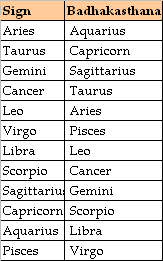
In Prasna Marga, Harihara has given the analysis of an horsocope based on Badhaka point of view. He says that for all movable signs, the 11th house therefrom is the badhaka sthana, for all fixed signs, the 9th therefrom are their badhakasthana and for all the dual signs, the 7th therefrom are their badkasthanas. Thus for the 12 signs of the zodiac, the badhakasthanas are:


In this method, the quadrants of the house of harm can also be harmful. This is based on the principle of Paraspara Karaka i.e. doing each other’s job when the planets/signs are placed in mutual quadrants. Paraspara Karaka means, you pat my back and I shall pat yours or you kick my back and I shall kick yours. The patting or kicking is dependent on the natural relationship of the planets under consideration. Thus if natural enemies are placed in the quadrants, they shall fight and when natural friends are placed in such position, they shall work with each other in harmony.

From the placement of the badhakesh (lord of the badhakasthana) or planets in the badhakasthana, we can judge the wrath of others and their result consequences in our lives in form of troubles. The wrath of following are discussed here under:

1. Wrath of deity
2. Wrath of Sarpadeva or divine sepents
3. Wrath of parents
4. Preta Bhadha
5. Dristi Badha
6. Abhichara

Wrath of Deity
The wrath of the deity is to be judged based on various factors. The 12th house from the Atmakaraka is the place of the Ista Devata and it is from the 12th house from the Badhakesh that the past life history of maintenance of the deity is to be deciphered.

The following guidelines are the key to the analysis of wrath of deity
1. Badhakesh is placed in an adverse place and afflicted.
2. If a Malefic planet is placed in the 12th house from the Badhakesh, it indicates that the worshipped image was mutilated.

This brings the wrath of the deity signified by the Badhakesh. Depending on the malefic planets [Rahu, Saturn, Mars] / Upagraha [Guika, Mandi] involved, the following can be inferred: -

(a) Gulika/ Rahu: Gulika is the son of Saturn and extremely diabolical. It rises at the end of the Saturn's portion in the eight part division of the day. Gulika shows poision and Rahu indicate serpents. Hence this indicates some blemishes related to serpents such as a curse of the Serpent deity or a serpent having touched the image of the deity has made it very impure.

(b) Saturn: Pollution /dirt on the image/ temple.

(c) Mars: Disputes /bad management of worship/ image/ temple etc.

The fault leading to the wrath of the deity can be narrowed down as follow. Here we must understand that the if Badhakesh is ill placed and the 12th from the badhakesh is afflicted, the we can be certain that the native shall have wrath of a deity. The reason can be divined from:

1. The malefic influences on the 12th from the badhakesh and/ or
2. The badhakesh itself and/ or
3. From the house where the badhakesh is placed

Cause of Wrath based on placement of Badhakesh in different houses [Ch15, Sl 11],
1. Lagna: Lagna shows image and hence this means that the idol has been mutilated.

Influence of planets on Badhakesh in Lagna:
a. Mars: breaking idol, image or any sacred object associated with the deity. A fresh idol has to be installed in a temple.
b. Saturn/ Rahu/ Gulika: Saturn rules dirt, Gulika poison and Rahu impurities. Thus if they influence the badhakesh, it indicates that pollution and dirt have made the idol impure.
c. If Sun associates, then it is due to birds. (Birds are ruled by Sun)

2. Fourth house: Fourth house shows the place of worship or the temple and hence it means that that the temple is either broken, desecrated or forgotten.

Influence of planets on Badhakesh in Fourth House:
a. Mars: The temple is either broken or dilapidated and needs repairs
b. Saturn: The temple has been forgotten (Saturn rules loss of memory)
c. Saturn/ Rahu: The temple is desecreated (Saturn rules dirt and Rahu rules impurities) and needs to be sanctified.

3. Second or Eleventh house: If the badhakesh is in one of these two houses, these houses being the dhana and aya bhava respectively, it indicates that the deity’s wealth has either been stolen or misappropriated.

The nature of the property can be judged from the nature of the sign. This property is either Dhatu (Inanimate object), Moola (grains, trees, lands etc) or Jeeva (Men, Animals etc) depending on the Lagna as being movable, fixed or dual.

The nature of the sign is however, overridden by planets if they conjoin the Lagna. Mercury and Jupiter signify Jeeva, Sun & Venus signify Moola and the others viz., Moon, Mars, Saturn and Rahu signify Dhatu. This can also be judged from the placement of the badhakesh in different nakshatras. For that matter the naksatras reckoned from Aswini are in the order of Dhatu, Moola & Jeeva.

Similarly, inferences can be made from the other houses.

Remedial measures
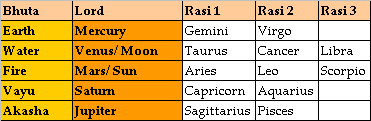
Since the dispositor of a planet indicate what sustains the planet and the house and also represent the mental and psychological aspect of a house or planet, the remedy of the sin committed against the deity can be seen from the dispositor of the badhakesh. The tattva (Elements) of the dispositor of the badhakesh, shall indicate, which remedy can propitiate the angry deity. The remedies based on the tattvas are given below:
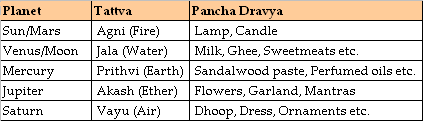


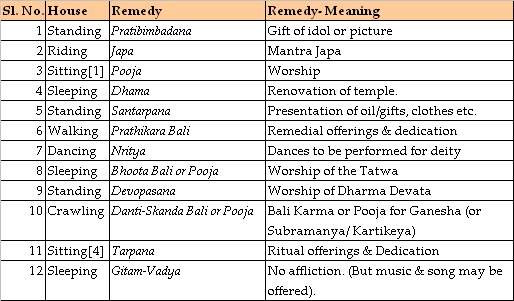
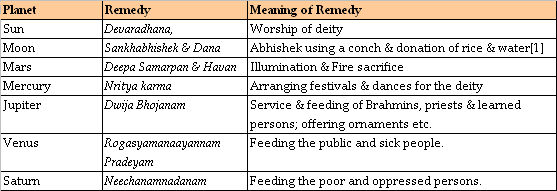
Further Remedies are given based on the house where the badhakesh is placed and also the planet who shows the cause of the wrath(This can be the afflicted badhakesh itself of the malefics in the 12th from the badhakesh). They are as follows:

Remedies based on placement of the Badhakesh in different Houses

Remedies based on the obstruction by planets
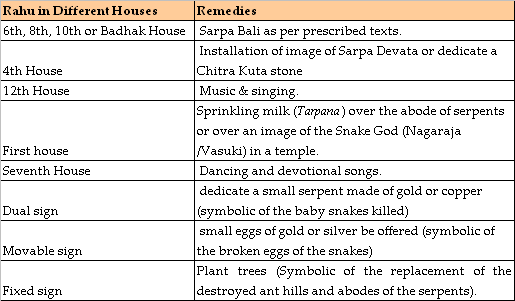
Wrath of Sarpa Deva In jyotish the planet which signify the serpents is Rahu. The placement of Rahu in different parts of the horoscope and the evil influences it exerts show varity of troubles due to wrath of serpents. Based on the nature of influences on Rahu, the serpents can be of various types. Though curses of the Divine Serpents have already been dealt in the section above, placement of Rahu in 4, 6, 7, 8, 10, 12 house requires additional attention and propitiation.

Nature of Wrath: 1. If Rahu is connected in any way with Badhakesh, it becomes extremely diabolical. The dasa of such Rahu could be extremely troublesome. Whenever such placement occurs, remedial measures are compulsory.

2. Jupiter represent the divine qualities and its influence on Rahu while simultaneously influencing Badhakesh, it shows divine nature of the serpents. Thus, if Jupiter associates with the Badhakesh and is placed in a Dusthana [6/8/12] and if Rahu is in a quadrant from Jupiter, then the curse is from superior or divine serpents.

3. In the above combination, if Gulika is in quadrants instead of Rahu, then these are inferior serpents. This is because, Gulika is the son of Saturn and is known for its diabolical nature. The nature of Gulika is to give poison and if it is involved in the wrath of serpents, the trouble could be extrenely strong, as though the life of native has become full of snake venom. Such combination requires immediate propitiation.

4. If the Sun associates with Rahu, then the serpents are beneficial and essentially intent in long term good.

5. Similarly, the Moon associating with Rahu shows evil-minded serpents intent on causing disaster.

Remedies:
The following remedies have been prescribed in the Prasna Marga and other traditional texts
Wrath of Parents

1. The Badhak sign should be Aries/ Scorpio (indicating the anger/ fire of Mars) to show the presence of a curse. The Sun (natural significator of father) should be in this Badhak sign in Rasi or Navamsa to show the curse of father. Similarly, the Moon (natural significator of mother) should be in the aforementioned Badhak sign to show the curse of Mother.

2. The Badhakesh associated with Leo & with Mars/Saturn shows the anger/sorrow of the father or some paternal elder respectively. The Badhakesh associated with Cancer & with Mars/Saturn shows the anger/sorrow of the mother or some maternal elder respectively.

3. 6th lord in 9th house or 9th lord in 12th house or the Sun in the sixth shows the displeasure of father. Similarly, the 6th lord in 4th house or 4th lord in 12th house or the Moon in the 6th house shows the displeasure of mother.

Remedies:
Serve your parents if they are alive. Perform Shraddh or work for some elderly persons in the memory of your parents if they are dead. Mars so placed shows the curse of brother, Venus of spouse etc. The ritual called Tila homa can be performed if the parent is dead.

Preta Badhak
If the funeral ceremonies or annual rites called Shraddh of the dead are not performed, then, it is believed that such a dead person remains in the form of a Pisacha & affects relations. The presence of Gulika/ Ketu in the Badhak sign shows the danger.
The malefic associating with Gulika shows the cause of death of the Pisacha. Some of such combinations showing the death is given below:

1. If Gulika/ Ketu is in any manner associated with Mars by conjunction, aspect or is placed in Aries or Scorpio, it shows sudden death or accident, burns, weapons, smallpox etc.

2. If instead of Mars, the association was with Saturn, misery & poverty may be the cause of death.

3. Rahu associating with Gulika shows snakebite and other deadly poisons.

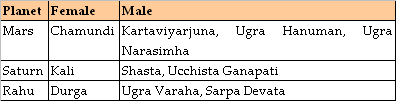
Similarly, the sign occupied by Gulika/Ketu show the sex of the Pisacha. If Gulika associates with the 4th house or lord in some manner, then the Pisacha is related to the family, if not, then it is from outside. The ashtottaramsa [108th Division of a sign. If in the beginning, young age and if in the end of the sign, old age is indicated] is the age of the Preta/Pisacha.
Remedies include Parvana Shraddh, Tila Homa etc. Depending on the affliction, Pooja/mantra of Ugra Devata should be prescribed.

Dristi Badha
Dristi means sight. Such kind of obstruction appear in life is some of the person related to us becomes jealous or evil towards us and thus exert invisible evil influences. The “evil eye” has been classified as three kinds of demons. Their names are always “Kamas” as the evil eye is causes by desire (Kama).


1. Ranthu Kamas causes worries and is indicated by the Badhakesh in Lagna or associating with Lagna Lord and Gulika.

2. Hanthu Kamas is intent on killing, and is seen by the association of the Badhakesh with the 6th or 8th house or its lord and the Lagna or Lagna lord. Relief comes from the aspecting benefic planet.

3. Bali Kamas desires some form of Bali (sacrificial offering). This is indicated by Rahu /Gulika is in 4th ,5th ,7th or 8th house. If 6th lord conjoins /aspects, the problem is due to enemy’s action.

Remedies
Natural benefics have the ability to mitigate the evils in the horoscope. If such planet is in quadrants to the Rahu/ Gulika or aspecting or associating with the Badhak, gemstones of the planet should be worn and the deities indicated should be worshipped and given offerings.

Abhichara Abhichara means black majic. This is something which is practiced in many ways in different parts of the world, invoking the negetive energies. The basic motive for black magic is driving the enemy away from the locality, kill him or cause Lunacy. This can involve things such as giving him food (polluted)/burying material inside his house etc.

Combination for Abhichara: 1. Badhakesh association with 6th house or lord.

2. 6th lord in 1st, 7th, or 12th house as Mars occupies or aspects Lagna.

3. Ketu is 1st, 4th, or 10th as Mars aspect Lagna.

Remedies
1. Mritunjaya Japa, Ganapati or Tila Homa indicates the relief.

General Remedial Measures
1. Jupiter [who represent Sadashiva or Maha-Vishnu] & ninth lord help /protect.

2. A natural benefic in the ninth or ninth Lord in strength in a quadrant or Jupiter in Lagna/aspecting Lagna are a few of the combinations for protection.

3. If malefic are in quadrant to them, they will strongly block the efficacy. The ninth Lord can also be the Lord of 2, 4, 6, 8, 10 & 12 houses respectively. The other house influencing the ninth house would show the deity who need to be worshipped. For example, if the ninth Lord is also Lord of second house then, start the remedial process by worshipping the Kuladevata.

4. If any planet conjoined or aspected by a natural benefic or a natural benefic itself, is in Lagna, then the deity indicated by the benefic planet shall surely protect the person.

5. If the ninth Lord associates with the Badhak House or Badhakesh, then the deity he worshipped in his previous birth has been neglected, thereby leading to misfortune and troubles.

6. If the fourth Lord is associated with the Badhak House or Badhakesh, then it is the Grama Devata who need to be worshipped.

7. If the second Lord associates with the Badhak House or Badhakesh, then it is the Kula Devata. Advise resumption of worship immediately.
Marriage Compatibility

Introduction
Marriage compatibility is an important contribution of Jyotish to the world as only it can foresee any problems in the married life of a couple and can precisely determine which area shall the problem root from. This is done with kuta matching as enumerated by Harihara in his immortal classic Prasna Marga. However, it is not possible to match all the kutas and here we must appreciate that nothing in this world is perfect and we need to compromise at various places. Compromises may be made in various kutas, however it should not be made in the five important kutas namely vasya, mahendra, yoni, Janma Rasi and lord of the Janma Rasi. There are three more kutas, which are to be considered very important, viz., gana, dina and stree-deergha. Besides this the Brahmins should also consider Gotra Kuta.

There are two kinds of Kuta, one which contribute points towards the 36 point scheme and the other does not. The Kutas which contribute to the 36 point schemes are Nadi, Rasi, Gana, Graha Maitri, Yoni, Dina, Vasya and Varna in the decreasing order of importance, with nadi kuta contributing the maximum of 8 points and Varna Kuta contributing the minimum of 1. Even though these kutas can be used for getting a mathematical value of relative compatibility, what is more important is to understand the nature of compatibitlity. Thus, the kutas which do not contribute to the kutas need not be ignored and checked for various aspects of marital relationship.


Point based Kuta
The maximum point that can be attained in each of the kutas are mentioned against each of the kuta in brackets.

1. Nadi Kuta: (8) Compatibility of physiological aspects
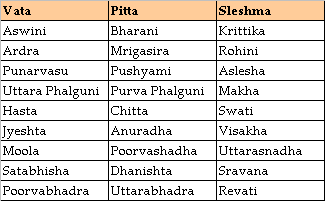
Nadi means several things but in reference to astrology, it signifies pulse or nervous energy indicating the physiological and to a certain extent hereditary factors. The Hindu medical works enumerate three Nadis or humours, viz., Vatha (wind), Pitha (bile) and Sleshma (phlegm). A boy with a predominantly windy or phlegmatic or bilious constitution should not marry a girl of the same type. The girl should belong to a different temperament. The three Nadis are ruled by the different constellations as follows:


Principle: If the constellation of the groom and bride fall in different columns, then agreement between the couple will be good. If the stars of the bride and groom fall in the first of last column, it is passable, however they should not fall in the middle column.

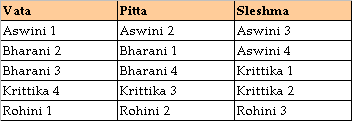
Nakshatra Pada Kuta Principle: If Nadi Kuta is not present on the basis of the Nakshatras, then the same may be reckoned taking into account the Nakshatra Padas. Thus, the different quarters will be governed by the three humors (Nadis). Beginning from Aswini 1, the counting should be done forwards and backwards in threes as given below:.


In the example considered above, both the constellations fall in the middle line and hence Nadi Kuta is completely absent.


2. Rasi Kuta: (7)
Happiness, auspiciousness and harmony in marriage

Principle 1: The male born in the 2nd, 3rd, 4th, 5th and 6th Rasis from that of the female should not enter into wedlock. If both have the same Janma Rasi, marriage can only be done provided both are not of the same Janma Nakshatra. This means that the Janma Rasi of the man should not be in the Adrisya portion from the Janma Rasi from the woman. From any sign, the Adrisya (Invisible half) are the Lagna (beyond the cusp) to the 7th (before the Cusp), for practical purpose this can be taken as 2nd to 6th.

Madhavacharya has given more specific effect of the placement of the male’s Janma rasi in the unfavorable positions from the females Janma rasi. They are as follows:

2nd: Loss of Money
3rd: Sorrow
4th: Quarrels and Misunderstanding
5th: Loss of Children
6th: Diseases, Danger and Separation

Principle 2: Along with the placement mentioned above, the placement in the 8th and 12th from the Janma rasi of the Women is not favorable. This is understandable, that the Dusthana placement of the man’s rasi from that of women’s cannot be favorable for conjugal happiness as they would either be inimical or indifferent from each other.

Principle 3: Even if the lords of the man’s and woman’s rasis are foe, if they are 7th from each other, this can be accepted as very good.


Riders:
1. If the Janma Rasi is of the male is not in a favorable place from the Janma Rasi of the Female, the blemish can be reduced, if the lord of those rasis are mutually friendly. However, the blemish intensifies, if the lords are inimically disposed.

2. When the women is born in an odd Janma Rasi, then the man born in the 6th and 8th there from can be taken as an optional measure. If she is born in even Janma Rasi, the man born in the 6th should be rejected and the 8th can be accepted.

3. If the Janma Rasi of both the man and women have vasya and do not have vedha, then the 6th and 8th position of the man’s rasi from the woman’s one can be accepted. We shall study the vasya and vedha dosha later.

4. Harihara does not attach much blemish to the 3rd and 4th house positions for the Janma Rasi of the male from that of the female as this shall neither indicate poverty, nor serious quarrels leading to estrangement nor loss of children. Sorrow is a part and parcel of human birth and this should not be taken as a criterion for marriage dissolution.

5. The same Janma Rasi is allowed as long as the couples don’t have the same Janma Nakshatra. However, if they happen to be the same, marriage is permissible provided it is not Jyestha, Moola, Purva-ashadha, Pushya, Aslesha, Magha, Hasta, Rohini, Dhanistha, Shatabhisaj, Ardra or Bharani.


3. Gana Kuta: (6)
Increase of affection & bond with time between the partners

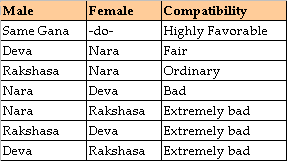
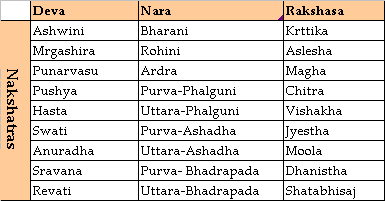
Principle: The Nakshatra are divided into three categories of Deva, Nara and Rakshasa. Their compatibility is given below:


The Gana of the Nakshatras


There are three levels of analyzing this compatibility, nameloy:
a. Janma Nakshatra:
b. Lagna Nakshatra:
c. Chandramsa Nakshatra: Find the Nakshatra of the Chandra Navamsa for the boy and girl. If there is compatibility or there is stree-deergha, the objection of a boy of Nara gana marrying a girl of Rakshasa gana can be safely ignored.

Astrologically three Ganas (temperaments of natures) are recognised viz., Deva (divine), Manusha (human), and Rakshasa (diabolical). Deva represents piety, goodness of character end charitable nature. Manusha is a mixture of good and bad, while Rakshasa suggests dominance, self-will and violence. These different natures are indicated by the birth, constellation. A distaste for piety and religious disposition cannot be easily associated with piety and religious nature. A difference in beliefs and dogmas cannot always be overbalanced by sexual compatibility. Hence one born in a Deva constellation is not able to get on well with a person born in Rakshasa constellation. – BV Raman
BV Raman opines that Nara or a Deva man should not marry a Rakshasa girl unless there are other neutralizing factors. But marriage between a Rakshasa man and a Deva or Nara girl is passable. If marriage is brought about between prohibited Ganas there will be quarrels and disharmony. So that the couple would always welcome an opportunity for separation and divorce.


4. Graha Maitri: (5)
Life style & objectives of life, Psychological disposition
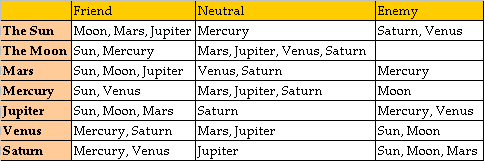
Principle 1: If the lords of the Janma Rasi of both are mutual friends or are owned by one planet, the match is favorable.

Principle 2: The mutual placement of the lords of the Janma rasi of the couples should determine the extent of the compatibility.

Graha Maitri Table


5. Yoni Kuta: (4)
Prosperity and financial stability

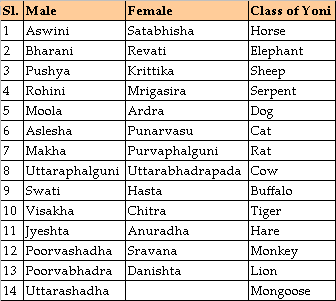
Principle: If the girl is born in a female Nakshatra and the boy is in a male, the couple will have financial stability. If both are in female Nakshatra, there will be loss of wealth. If both are in the male Nakshatras, it is to be rejected.

There are two kinds of Yoni Kuta:

1. Nakshatra Yoni


Hostile animals, which are to be avoided for Yoni Kuta
§ Cow and Tiger;
§ Elephant and Lion;
§ Horse and Buffalo;
§ Dog and Hare;
§ Serpent and Mongoose;
§ Monkey and Goat;
§ Cat and Rat

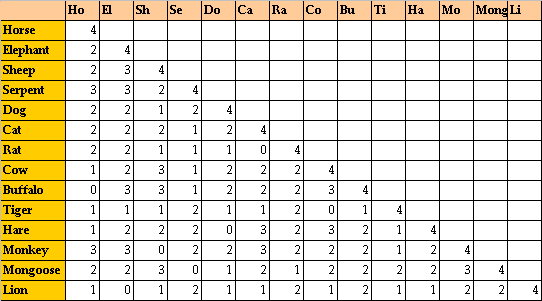
There is various extents to which the Nakshatra yoni match. The following table shows the extent of match between different yoni. The maximum is 4 and minimum is 0


2. Rasi Yoni:
§ Capricorn, Pisces : Pakshi
§ Cancer, Scorpio: Reptile
§ Aries, Taurus, Leo: Pasu
§ Gemini, Virgo, Libra, Aquarius, Sagittarius: Nara

Compatibility of Rasi Yoni
§ Pasu + Pasu – Good
§ Pasu + Nara – Fair
§ Pasu + Pakshi /Reptile – Bad
§ Human + Pakshi /Reptile – Bad


6. Dina Kuta: (3) Length of married life

Principle 1: This is based on the Navatara Chakra of the female chart. In the Navatara chakra, the 27 Nakshatras are divided into three groups of nine each, starting from the Janma Nakshatra. The first group of 9 is called as Janmarsha, the 10th to 18th Nakshatra from the Janma Nakshatra is known as the Karmarsha group and the 19th to 27th Nakshatra is known as the Adhanarksha.

The man’s Nakshatra in the 3rd (Vipat), 5th (Pratyak) or 7th (Naidhana) from the Janma Nakshatra of the woman is harbinger of troubles and shows separation. The 6th (Saadhana) Nakshatra is also inauspicious, however, not as bad as the 3rd/ 5th or 7th.

Principle 2: The man born in the 88th or 108th Navamsa from the Navamsa Moon of the women is not auspicious. 88th Navamsa is the 4th Navamsa from the Navamsa Moon, whereas 108th is the 12th from the Moon sign. 108th Pada is just the pada before the Moon’s Nakshatra pada, whereas the 88th pada is 20 padas before the woman’s Janma Nakshatra pada.

Principle 3: The farther the Janma Nakshatra of the boy from the Girl’s Nakshatra, the better it will be for him for their happiness.

Pt. Sanjay Rath says:
1. Dina Kuta means mating of charts or compatibility for 'day to day living and sharing of happiness and sorrow'. The word dina simply means day and refers to the day to day living and sharing.
2. Dina Kuta is based on the Navatara chakra which is all too well known for astrologers. The transit of the natal Moon on the various naksatra is judged to give favorable and unfavorable results to the mind and its perception of the various events. The transit in naksatra 3,5 and 7 from Janma rasi are considered very unfavorable. This is the basis for the dina kuta matching. The point is that when two people marry then they should be supportive of each other during the days of worry and troubles. For example on a day when the Moon is in the 3rd from janma naksatra of the boy and he is sorrowful then this should be strong for the bride and she should be able to support him to tide over the difficulties. That is the reason why dina kuta is necessary.
3. To understand the working of Dina Kuta you have to study the janma and lagna naksatra of the couple and determine their compatibility in both the janma naksatra i.e. Moon naksatra as well as lagna naksatra. If dina kuta is not present in the janma naksatra matching then the couple will never really become very close to each other and they will not be of any support to each other during difficult days and sharing will be low. On the other hand if dina kuta is not present from lagna naksatra then they cannot agree on major issues and should be advised to respect the views of their partner instead of getting into meaningless arguments.
This is also one of the reasons why marriage between couples having the same janma naksatra was not encouraged.


7. Vasya Kuta: (2)
Affection and love between the partners
This indicates the degree of magnetic control or amenability the wife or husband would be able to exercise on the other.

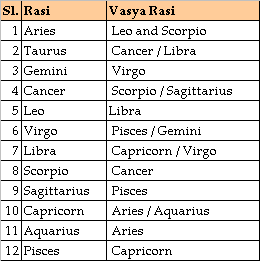
Principle: If the Janma rasi of the man is the vasya rasi of the women’s Janma rasi or vice versa, then the vasya kuta prevails. If the groom’s rasi happens to be the vasya rasi of the bride, the bride shall dearly love the groom and vice versa. Thus, If the Janma rasi of the man and woman happens to be the Vasya rasi of each other, then the affection among them is the strongest.

The Vasya rasi for different rasis are given hereunder:


In the following cases, the rasi of the bride and groom becomes the Vasya rasi of each other.
Gemini – Virgo – This is 4th – 10th from each other
Cancer – Scorpio – This is 5th – 9th from each other.


8. Varna Kuta: (1)
Ideals and Principles that drive the couple’s life
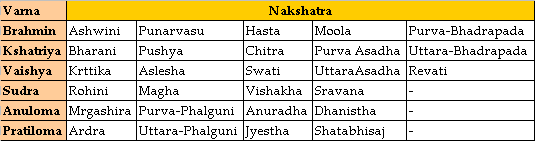
Principle 1: The six nakshatras beginning from Ashwini to Ardra, Punarvasu to Uttara, Hasta to Jyestha and Moola to Shatabhisaj in the regular order represent the Brahmins, Kshatriya, Vaishya, Sudra, Anuloma and Pratiloma caste.

If the man and the woman belong to the same caste, then it is the best. Otherwise, if the man belongs to the higher caste than that of the woman, it is permissible. However, if the woman’s caste is higher than that of the man, it is not permissible.

Principle 2: Anuloma and Pratiloma: If one of them is Anuloma and other belongs to one of the other four castes, then it is passable. However, this is rejected is one of them is Pratiloma and the other one belongs to the rest four.


Kuta without points
9. Mahendra Kuta:
Blessings in the married life; Well-being; Longevity

Principle: If the Girl is born in the 4th Nakshatra from that of the Boy, it is Mahendra; if she is born in the 7th, it is known as Upendra. Mahendra gives wealth and Upendra gives children.


10. Stri Deergha: Long life to the Husband
Principle: The male Nakshatra should be more than 15 stars away from that of the female. If that is not so, long life of the male is not supported. Other factors like Navamsa have to be considered.

Rider: This consideration can be ignored if Rasi Kuta and Graha Maitri is there..


11. Rajju Kuta:
The Asterism can be classified into 5 categories namely:


Principle: If the Nakshatra of the couple do not fall in the same category, it is auspicious. If the Nakshatra fall in the same category, the results are as follows:
§ Kantha – Widowhood
§ Kati- Poverty
§ Pada- Distant Travels
§ Siro- Death
§ Kukshi – Loss of children


12. Vedha:
Obstacles in Married life

Principle 1: The Nakshatra of the couple should not fall in the vedha group as mentioned below.
§ Aswini and Jyeshta;
§ Bharani and Anuradha;
§ Krittika and Visakha;
§ Rohini and Swati;
§ Aridra and Sravana
§ Punarvasu and Uttarashadha;
§ Pusayami and Purvashadha;
§ Aslesha and Moola;
§ Makha and Revati;
§ Purvaphalguni and Uttarabhadrapada;
§ Uttaraphalguni and Purvabhadrapada;
§ Hasta and Satabhisha,
§ Mrigasira and Dhanishta.

Principle 2: Even if there is other agreement such as Vasya, etc., Vedha will prevail.


13. Gotra Kuta:
For prosperity of the lineage after marriage

Principle: If the boy and the girl belong to the same Gotra, it brings disaster to the lineage. If the gotras are different, then the lineage shall prosper.


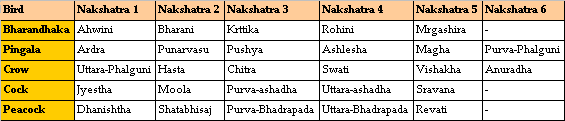
14. Vihanga Kuta: Dominance of one partner over other

Principle: If the Nakshatra of the couple indicate the same bird, it is auspicious. Otherwise, one bird shall dominate over the other in the descending order of Peacock, Cock, Crow, Pingala, Bharandhaka


15. Yonyanukulya:
Sexual compatibility
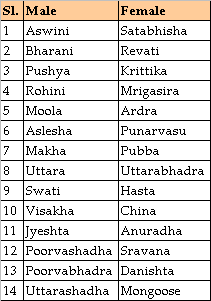
Principle: If the girl is born in a female Nakshatra and the boy is in a male, the couple will have sexual compatibility. If both are in female Nakshatra, it is acceptable. If both are in the male Nakshatras, it is to be rejected.

The male and female Nakshatras along with their yoni are given hereunder:

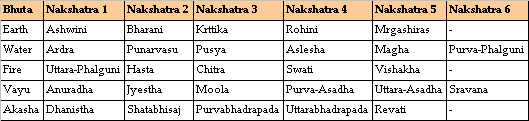
16. Bhuta Kuta:
Prevailing element in the personality.
Principle: If the Nakshatra of the couple are of the same bhuta, it is favorable. If they are different, the results are as follows:

Fire+ Air – Favorable
Earth +Other – Favorable
Water+ Fire – Bad
Nakshatra Bhuta: Psychological nature

Rasi Bhuta: Spiritual nature.


17. Vayanukulya:
Continuation of Lineage
Principle: If the groom is 3 times older than the bride, it is considered as good. If he is twice old, it is passable; if he is older only by a few years, it results in sorrow. If the bride is older, the family shall become extinct. Thus for such cases, it forebodes a death in the family or there will be no male issues
18. Ashtakavarga:
Mental Compatibility
Principle 1: if the Janma Rasi of the groom falls in the sign which, in the Moon’s astakavarga of the girl’s chart has more bindu, it is good. Similarly, if the Janma Rasi of the Girl falls in a sign which, in the Moon’s astakavarga of the boy, has more bindus, it is equally good.

Principle 2: Find out the Kaksha in which the Moon is found in the girl’s horoscope. If the Janma rasi of the boy falls in the sign of the lord of this Kaksha, the compatibility is good. The reverse is also holds true.

Kakshya: Each sign is divided into 8 Kakshas of 3d 45m each lorded by Saturn, Jupiter, Mars, Sun, Venus, Mercury, Moon and Lagna.


19. Chittanukulya:
God's will
This is the over-riding power of God and when two people are in love, the chart matching becomes meaningless, as there is the will of God in this. If they are normal people then their affection should be tested with time and if one is spiritual then his/her falling in love for marriage and children has a divine purpose and is beyond the normal rules of Jyotish compatibility. In this case, since the couple has expressed their love for each other, they should be encouraged to enter wedlock.
20. Aya-vyaya:
Income and Expenditure
Principle: Count from the Nakshatra of the bride to that of the groom. Multiply this number by 5 and divide the product by 7. The reminder is Vyaya or expenditure. If the counting is again made from the Janma Nakshatra of the groom and the same calculation is repeated, the reminder indicates “aya” or gain or income.

If the aya is greater than vyaya, marriage brings all round prosperity. If this is reverse, the couple will experience poverty.
21. Rna-Dhana: Overall marital happiness
Principle 1: Count from Aswini to the Janma Nakshatra of the groom as well as the bride and total them up. Add to this sum 13. From this total figure subtract 32. Divide the difference by 5. Check the reminder for the following results:

X= Reminder [(Groom+Bride+15-32)/5]
1- Acquisition of children
2- Death of one of the couple
3- Prolonged illness
4- Prosperity
5- N.A.

If the total after adding 13 does not come to 32, then the counting should be made from Janma Nakshatra to Aswini.

Principle 2: Count from the Janma Nakshatra of the couple to Aswini. Add the two figures and deduct the sum by 5. Check the reminder for the following results:

1- Prosperity
2- General progress
3- Calamities
4- Acquisition of wealth
5- Disasters

Principle 3: If the Janma Nakshatras of the groom and the bride fall in the first group namely Ardra, Hasta, Purva-Ashadha, Uttara-Ashadha, there will be great progress. If they fall in the 2nd group namely, Krttika, Rohini, Mrgashira, Magha, Purva-Phalguni, Uttara-Phalguni, Anuradha, Jyestha, Moola, Dhanistha,, Shatabhisaj, Purva-Bhadrapada, prosperity shall follow immediately after marriage. However, if they fall in the 3rd group- Aswini, Bharani, Chitra, Swati, Vishakha, Uttarashadha, Sravana and Revati, expenditure and debts shall follow the marriage.

______________________________________
Upapada Matching
Upapada is the arudha of the 12th house in any horoscope. This is computed by counting as many houses from the 12th lord as the lord gained from the 12th house. If the upapada falls in the 12th or the 6th house, then count 1oth from the sign again to arrive at the final upapada.
Upapada tells a lot about the spouse, one who is committed to follow you for the whole lifetime or at least for the duration of the marriage. The various results related to upapada can be studied from jyotish classics such as Brhat Parashara Hora Shastra or Upadesha Sutras of maharishi Jaimini. The matching of Upapada is very crucial as this shows, how the images of the partners are related to each other and hence has a strong say on the marital affairs and harmony. The matching criteria for upapada is given below-
1. The Lagna of the bride should be in trine or 7th from the Upapada or in the paka upapada and vice versa.
2. The Upapada and AL should be placed in Kendra or Trine or 3/11 to each other. Otherwise, this shows lack of harmony in the relationship.
3. The 2nd of Upapada rules the longevity of the marriage. If the 2nd house or the lord is afflicted by malefics such as nodes, then the marriage can be in serious troubles. This is also true if the lord is debilitated and aspected by malefics.
4. The remedy of all marriage troubles is to fast on the day ruled by the Upapada lord.

______________________________________
Marriage date 1. Marriage should normally occur in an odd year of the male and even year of the female. Otherwise this forebodes troubles.
2. Marriage should happen when Jupiter aspects or transits the 2nd from Upapada.
Finding the marriage date using dasas such as Vimshottari, Narayana, Naisargika dasa etc and through transits would be given in another article.

______________________________________
Special Considerations
Exceptions the Kuta matching
The following are the salvaging factors, if present; one can ignore certain incompatibilities in the Kuta.
1. The absence of Stree-Deerga may be ignored if Rasi Kuta and Graha Maitri are present.
2. If the Rasi of the girl is odd, the 6th and 8th Rasis there from are friendly. If the Rasi of the girl is even the 2nd and 12th there from become friendly. The evil due to the birth of the bride in a Rakshasa gana star may be ignored if Janma Rasi being 2nd and 12th, 9th and 5th or 6th and 8th, the lords of the Rasis are the same or are mutual friends.
3. Though Graha Maitri is by far the most important, it need not be considered if the couple has their Janma Rasis disposed in one and seven from each other.
4. Rajju Kuta need not be considered in case Graha Maitri, Rasi, Dina and Mahendra Kutas are present.
5. The evil due to Nadi Kuta can be ignored subject to the following conditions: -
6. The Rasi and Rajju Kuta prevail
7. The same planet is lord of the Janma Rasis of both the mate and the female
8. The lords of the Janma Rasis of the couple are friends

Common Janma Rasis and Nakshatras
In many cases, the Janma Rasis of the Janma Nakshatras of the bride and bridegroom would be the same. Special attention is paid by astrological writers to such exceptions and we shall throw some light on them for the edification of our readers.

Common Janma Rasi: Views differ as regards the results accruing from the Janma Rasis being common. According to Narada, common Janma Rasi would be conducive to the couple provided they are born in different constellations. Garga opines that under the above circumstance, the asterism of the boy should precede that of the girl if the marriage is to prove happy. Incase the reverse holds good (Stree-purva). i. e., the constellation of the girl proceeds that of the boy, the alliance should be rejected. This view is supported by other sages, viz., Brihaspati and Bhrigu. In fact, the author of Muhurtha tattva goes to the extent of saying that in cases of common Janma Rasi, provided the man's constellation is preceding the girl's, the Kutas or adaptability need not be applied at all.

Common Janma Nakshatra:
This is a further extension of the principle of common Janma Rasi. The Janma Nakshatras of the bride and bridegroom, being one and the same, are approved in case of Rohini, Aridra, Makha, Hasta, Visakha, Sravana. Uttarabhadra and Revati. The effect would be ordinary if the common Janma Nakshatras are Aswini, Krittika, Mrigasira, Punarvasu, Pushya, Pubba. Uttara. Chitta, Anuradha, Poorvashadha and Uttarashadha, Bharani, Aslesha. Common Janma Nakshatras is not recommended if the Nakshatras happens to be Swati, Jyeshta, Moola, Dhanishta, Satabhisha and Poorvabhadra .

Here again certain ancient authors hold that even though the Janma Nakshatras are same, the evil becomes nullified if the Padas are different. If the Janma Nakshatra belongs to two signs (e.g., Krittika) the Pada of the bride should relate to the preceding sign. For example, if Krittika is the common Janma Nakshatra, the bride should have her Janma Rasi in Mesha and the bridegroom in Vrishabha. If, however, the common Janma Nakshatra belongs to two signs equally (e.g., Mrigasira, Chitta, etc.) the sign for the first two quarters should be that of the bridegroom.

The couple should not have the same Janma Rasi, same Janma Nakshatra and Pada. However, in regard to Satabhisha, Hasta, Swati. Aswini, Krittika, Poorvashadha, Mrigasira and Makha, the evil given rise to by virtue of common Janma Rasi, Nakshatra and Pada gets cancelled if the couple are born in the first quarter.

Destructive Constellations
Certain parts of Moola, Astesha, Jyeshta and Visakha are destructive constellations
§ Moola (first quarter) for husband's father
§ Aslesha (first quarter) for husband's mother
§ Jyeshta (first quarter) for girl's husband's elder brother
§ Visakha (last quarter) for husband's younger brother.


_____________________________________
The Kuja Dosha
A person suffering with Kuja Dosa is vulnerable to physical abuse from the partner. However, the dosha is counteracted by the conjunction of Mars with Jupiter or Mars with the Moon; or by the presence of Jupiter or Venus in the ascendant.


BV Raman
-----------------------
The position of Venus and Mars is very important in judging marital relations. Mars whose element is fire rules marriage. Where he is badly situated or associated in the horoscope of a male or female, it follows that the sacerdotal fire gets extinguished soon. Such unfavorable situation goes under the name of Kuja Dosha.

It must be noted that in determining marriage adaptability between two parties, there are several elements of much more importance than Kuja Dosha. And the evil influence accruing from the bad position of Mars is only one of the several elements.

It is unfortunate that throughout South India especially in the Tamil areas, much is made of the so-called Kuja Dosham and this bugbear has been the means of destroying the happiness of many families by preventing marriages otherwise very eligible and anxiously wished for. So far as our humble experience goes it is only in the Kerala Sastra that mention is made of Kuja Dosha. The stanza runs thus: Dhana vyayecha pathale jamitre chashtame kuja; Strinam bharthru vinasamcha bharthunam strivinasanam. This means: - "If Mars is in the 2nd, 12th, 4th, 7th and 8th houses in the horoscope of the female, the death of the husband will occur; similar situation in the husband's horoscope causes the death of wife."

The Lagna represents body, the Moon, mind and Venus, sexual relations. Therefore, the houses have to be reckoned with reference to all the three, viz., Lagna, Moon and Venus. The dosha (evil) is considered weak when it exists from Lagna, a little stronger from the Moon and still more powerful from Venus.

The second house signifies family; the twelfth represents comforts and pleasures of bed. The fourth rules sukha or happiness. The seventh indicates husband and eighth represents longevity of the wife or husband. Hence the position of Mars in these houses is supposed to produce this peculiar dosha or evil. If Kuja Dosha obtains in the horoscopes of both the bride and bridegroom, the dosha gets cancelled. There are, of course, many good combinations which assure marital felicity and much importance need not be given to Kuja Dosha.

Granting that Kuja Dosha is a factor whose occurrence should not be ignored, there are antidotes which are not generally known to the rank and file of Hindu astrologers. If Mars is placed in the signs mentioned below corresponding to different houses, there shall not be any dosa:

§ 2nd - Gemini and Virgo
§ 12th - Taurus and Libra
§ 4th - Aries and Scorpio
§ 7th - Capricorn and Cancer
§ 8th - Sagittarius and Pisces.

In Aquarius and Leo, Mars produces no dosha whatsoever.

The dosha is counteracted by the conjunction of Mars and Jupiter or Mars and the Moon; or by the presence of Jupiter or Venus in the ascendant.

______________________________________
Fixing the Marriage Muhurtha § The lunar months of Magha, Phalguna, Vaisakha and Jyeshta are good. Kartika and Margasira are ordinary. The rest are not auspicious. Some sages opine that marriages can be celebrated in Pushya and Chaitra provided the Sun is in Capricorn and Aries respectively.

§ The following lunar days, viz., from the 11th day (dark half) to New Moon, Riktha Thithis, 8th, 12th and 6th should be rejected. The best lunar days are the 2nd, 3rd, 5th, 7th, 10th, 11th and 13th (of the bright half).

§ Monday, Wednesday, Thursday and Friday are the best. Sunday and Saturday are middling. And Tuesday should be invariably rejected.

§ The best asterisms are Rohini, Mrigasira, Makha, Uttara, Hasta, Swati, Anuradha, Moola, Uttarashadha, Uttarabhadra and Revati. The first quarter of Makha and Moola and the last quarter of Revati are inauspicious and they should be rejected. Constellations not mentioned here are unsuitable and they should be avoided.

§ The following yogas should be rejected: Vyatipata, Dhruva, Mrityu, Ganda, Vajra, Soola, Vishkambha, Atiganda, Vyaghata and Parigha.

§ Vishtikarana must invariably be discarded.

§ Among the zodiacal signs Gemini, Virgo and Libra are the best. Taurus, Cancer, Leo, Sagittarius and Aquarius are middling. The rest are inauspicious.

Elements of Muhurtha Chart:
In the election of a Muhurtha for marriage, as many of the 21 dosha are possible and should be avoided. The most important considerations however are
(1) The 7th house must be unoccupied by any planet
(2) Mars should not be in the 8th
(3) Venus should not be in the 6th
(4) Lagna should not be hemmed in between malefics
(5) Malefics should not occupy Lagna
(6) The Moon in the election chart should not conjoin any planet

Apart from the above, the usual Tarabala, Panchaka. etc., should be looked into. The calculation of Panchaka and Tarabala would be given in another article.

Jupiter, Mercury or Venus in Lagna, malefics in the 3rd or 11th, would constitute a formidable force in rendering the Lagna strong. The following are some of the special combinations which are supposed to fortify the marriage election chart:

1. Jupiter in the ascendant, Venus in the 8th and the Sun in the 11th - Mahendra Yoga.
2. Venus in Lagna, Jupiter in the 10th and the Sun and Mercury in the 11th-Vishnu Priya Yoga.
3. Venus in the 2nd, Jupiter in the 12th, the Sun in the 8th and Saturn in the 6th - Sreenatha Yoga.
4. Venus in Lagna, Jupiter in the 4th, Mercury in the 2nd and Saturn in the 11th - Samudra Yoga.
5. Mercury, Jupiter and Venus in Lagna - Vijaya Yoga.
6. Venus and Jupiter in Lagna elevated or otherwise strong - Jaya Yoga.
7. Saturn in the 3rd, Jupiter in the 6th, the Sun in the 10th and Mars in the 11th - Pushya Yoga.
8. Mars in the 3rd, Saturn in the 6th, Venus in the 9th, Jupiter in the 12th - Maharshi Yoga.
9. Venus in Lagna, Jupiter in the 11th - Ardhama Yoga.

References: 1. Prasna Marga
2. Muhurtha- BV Raman